Tuesday, June 1, 2021

Personalised Nutrition: What is it and does it really work?

 Everyone’s looking for that perfect diet, the one that’s just right for your own individual body type and allows you to finally lose those stubborn kilos once and for all. But while it might sound too good to be true, thanks to recent scientific advances, it’s now possible to have a diet that is specifically tailored to your genetic makeup.

It’s no secret that people respond to different foods and diets in different ways – we all have that friend or family member who can seemingly eat whatever they want and never gain weight – but exactly why and how these differences exist has long been a mystery. However, since the sequencing of the human genome back in the 1990s and early 2000s, the emergence of ‘nutrigenomics’, the science that looks at the relationship between our genes, what we eat, and our health has begun to provide some answers.

As humans, approximately 99.9% of our genes are identical, but it’s the 0.1% difference that makes us all unique. Our individual genetic makeup means that the way in which we metabolise nutrients, the interactions of enzymes and the biochemical reactions that occur in our bodies differ from person to person and therefore so do our responses to what we eat. And this is where personalised nutrition comes in.

How does personalised nutrition work?

Personalised nutrition is based on the idea that customised nutrition advice is likely to be more effective than the traditional ‘one-size-fits-all’ approach.There are now services available to the public through genetic testing companies which profile an individual’s DNA, provide a report based on their genetic makeup as it applies to their nutrition and lifestyle, and guide them to the most-likely-to succeed diet.

A report may provide information such as how an individual processes and stores fat, their ability to breakdown cholesterol, their caffeine sensitivity and food intolerances as well as their risk of certain chronic diseases such as obesity and cardiovascular disease.

What are the benefits?

Personalised nutrition promises to help clients achieve optimal health and disease prevention based on their own individual genetic makeup. There is the potential to assist an individual in working towards goals such as improved body composition and exercise performance, while also informing them about chronic diseases they may be predisposed to, allowing them the opportunity to make changes to their lifestyle to reduce these risks.

But is it too good to be true? 

When considering the future of personalised nutrition, the key word is ‘potential’. There’s no doubt that it holds huge promise, however, we need to better understand exactly how our genes interact with the food we eat before we can be sure of the legitimacy and usefulness of lifestyle interventions based on this information.

Monday, May 17, 2021

Our Nutritionists - Just a Click Away

Fitness Trainer Near Me

Your search for a fitness trainer near me hasn't come to an end? We’ve got your back. Our personal trainer & nutritionist will provide feedback each week to help you achieve your fitness goals. 

We’ll create a customized diet and nutrition plan based on your goals.

You can track your performance, nutrient intake, & see various milestones you’ve achieved through our award-winning mobile app.

If you wish to have the delivery of all your meals, we can arrange them weekly for an additional cost. As we have 600+ prearranged meal plan options

Your online personal trainer will provide low-calorie recipes and portion guides for your meals.

https://www.foundmyphysique.com.au/

Friday, April 16, 2021

Why Your Body May Need a Week of Light Training

Why Your Body May Need a Week of Light Training

Feeling tired? Drained? Not getting results from your training?

Are your muscles tight and body feeling heavy?

Are you lacking motivation for your training sessions and finding it hard to complete your workouts?

Are your number’s not improving?

You may need to incorporate a deload so you can come back STRONGER!


What is a De-load?

A deload week is a week of LOWER intensity training to let the body recover and ‘catch up’ with the stressful demands of regular heavy training routines.

Think of it as a “period of reduced training stress which continues until after the dissipation of fatigue symptoms”

Training puts large amounts of STRESS on the body. Our muscles give us the best feedback during a training session so they may be the one thing we concentrate on. We feel a good ‘pump’, burn, stretch or muscular fatigue. We use this to gage our performance during our sessions, however, these tissues are not the only tissues that receives the STRESS of training. Stress is also received by the nervous system, ligaments, tendons, joints, bones etc.

We have a good connection to our muscles and can tell when they are fatigued, tights or sore. However, it is very difficult to assess the current state of your tendons, joints, ligaments and the nervous system. These components may need recovery as well as your muscles. Stress can build up in the body and start displaying ‘signals’ (I list these below).

The purpose of the deload week is to allow the system to play ‘catchups’ and recover to full capacity, then the athlete can come back and perform at 100%.

Why do a deload week?

Your joints may need to recover – joint damage / repair is slow. Joints take longer to recover and often do not show signs of damage until they are in bad shake

Your tendons may need to recover – tendons are also slow to recover and do not show signs of damage until they are breaking down (this is known as the iceberg theory in physiotherapy – where the damage is more significant (bottom of the iceberg) than the pain that being felt (top of the iceberg))

Your nervous system may need to recover – symptoms listed below

You have not been getting stronger or improving on performance indicators

To get a new fresh sense of motivation for intense training

When should you do a de-load week?

Many coaches believe you should incorporate a regular de-load every 3-5 weeks of heavy training (to be safe). Some suggest that it may be a better idea to incorporate deloads when your body is giving you the signals that it may require a deload. This is termed a “reactive deload” and you are not setting it in advance, but rather, you implement it after noticing signals of fatigue or reduced performance.

What are the signals that I need to deload?

Your body will give you little hints that it may be in need of a deload. These signals can be subtle at first, but can become more obvious as they increase in intensity.

“listen to your body when it whispers, and you will not need to listen to it scream” 

These signals may come in the form of:

Performance indicators decreasing (strength, reps, form, etc)

Aches and pains in new locations or previous injuries

Tightness in muscles that doesn’t seem to be easing up easily

Feeling heavy and unmotivated to complete your workouts

A feeling of fatigue or lack of energy during the day

Finding it hard to hold yourself up straight and keep good posture

Feeling like you need more rest than usual or naps

Lack of motivation or drive

These signals can obviously be caused by OTHER reasons such as; lack of sleep, stress levels, poor quality nutritional intake, compromised immune system (slightly sick), digestive issues etc. However, for the sake of simplicity lets assume that all of these factors are accounted for and are remaining constant.

Side note: my take on impacting factors

I think there needs to be a clear reminder that some inexperienced people may perceive that they need a de-load but it could be due to other reasons:

Their technique may absolutely suck!

They may be performing provocative exercises

They do not know how to stretch / foam roll / recovery adequately

Their injury management is poor

They may have terrible mobility, tight hips or shoulders, making exercises they perform unsafe for them

They may be “smashing” themselves in the gym and using these deload periods to bounce back to poorer quality training

They may have tight muscles or knots which are mutilating their posture and overall energy levels

They may not be able to understand how the complexity of life events, stress and nutrition affect the body

Injury management, proper technique, mobility work and appropriate programming should not be confused with deloading

Without proper coaching, I would not trust a beginner or even intermediate athlete to know when to deload appropriately. Some may use a “deload” as an excuse to train less, instead of using it as a tool to come back stronger!

What benefits will I notice after deloading?

There are many reasons to deload, but the primary reason is NOT to take a break of training, rather it is to come back refreshed and STRONGER. When you take this week to let your body CATCH UP with your training demand, you may find your strength and vigour actually increases.

Joints, muscles and tendons have a chance to recover which is incredibly important for preventing injuries and long term training success (since most injuries are not muscular, but rather, tendon, ligament or joint related).

You may also find you can perform exercises with ease, to greater ranges of motion, due to central nervous system recovery and increases in mobility from loosening up tight muscles.

How should I modify my training for a deload?

Okay, so you have decided you may want to perform a de-load week. The procedure is relatively simple (in regard to training) but I like to add in additional recovery methods to boost the healing power of the system. You can read my blog on recovery methods here.

General Protocol: (it can vary depending on the circumstances)

Amount of total training sessions: Same

Total volume: Decrease by 25% – 4 sets becomes 3 sets

Weight lifted: Decrease by 20% – 100kg becomes 80kg

Reps performed: Decrease by 20% – 10 reps becomes 8 reps

General Rule: Don’t go beyond 4 reps from fatigue – this helps the nervous system

Overall Feeling: At the start of the week it will feel oddly easy and refreshing, at the end of the week you will be CRAVING the intensity of your previous training sessions

If you want to keep it simple – reduce everything by 20-30% and make time for addition recovery methods (basics list below)

Wednesday, April 7, 2021

InBody 570 Scan Interpretation Guide - Found My Physique

Interpretation Guide for InBody Scan From Nutritionist At Found My Physique

FREE Interpretation Guide for InBody Scan - Found My Physique

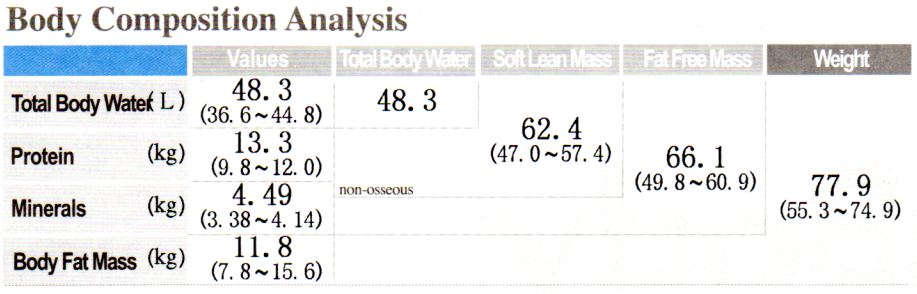
This page will give you a detailed briefing about every section of the InBody Scan results sheet.

Total body weight alone is not a clear indicator of a person’s overall health as it does not distinguish the amount of fat or lean body mass in the body.

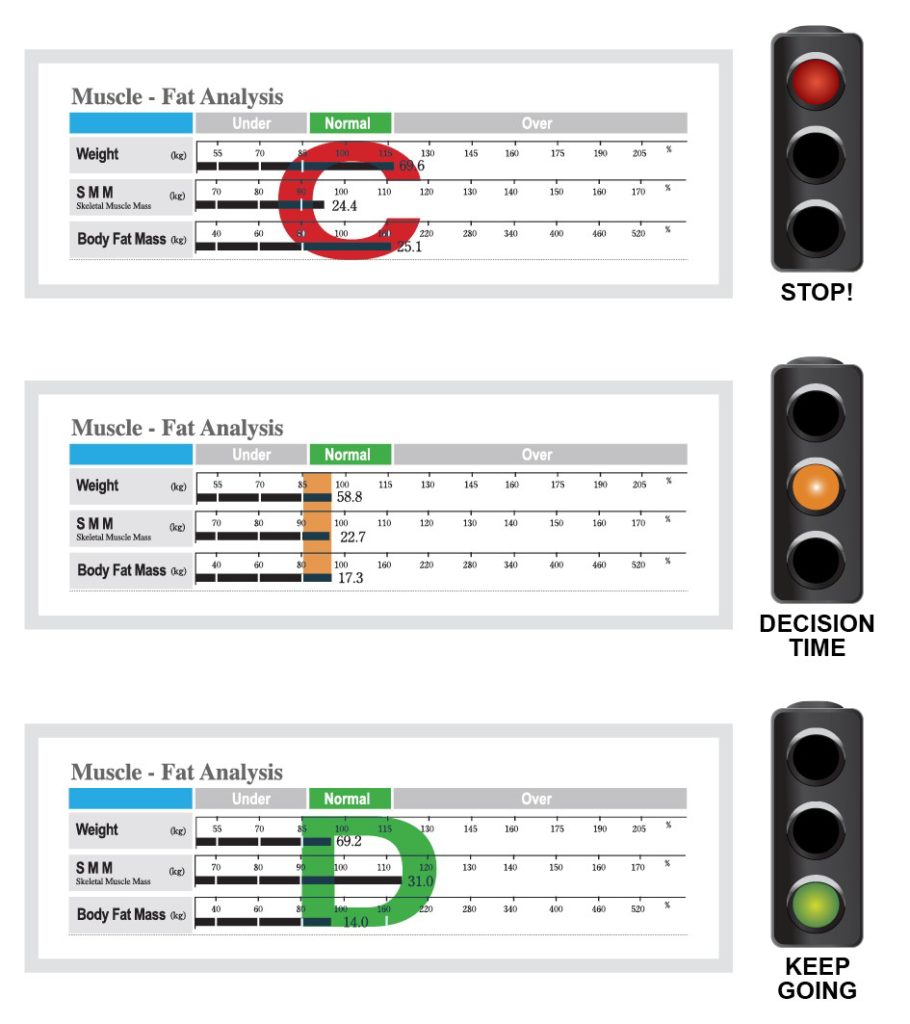
You can use your InBody scan to track various goals, and it is up to you to decide which metrics you wish to focus on for your training. For example: If your goal is muscle gain, you may concentrate on the SMM (kg) as well as balance out your limbs and weaker body parts in the Segmental Lean Analysis section.

If your goal is Body Fat Loss, you may want to focus on the increases and decreases in Body Fat Mass (kg) and (%) as well as weight recommendations and how far your results are from the ‘100% normal’ population data.

Basic Body Composition Analysis

InBody 570 Results Interpretation Body Scan Guide

Total Body Water
TBW is all the water in the body and is approximately 60% of your total weight. Ideally, your TBW should be in the normal range or over. Usually, individuals with a higher degree of muscle mass will have higher levels of TBW.

Protein
Protein consists of nitrogen, and high nitrogen levels within cells indicate good levels of muscle mass and health. A lack of protein implies a lack of muscle mass is possibly indicating poor nutrition and malnourishment. Protein is directly related to intracellular water. Therefore, a lack of protein suggests a lack of intracellular water, which in turn suggests poor nutrition. Ideally, your protein content should be within or exceed the average range set out below the reading.

Minerals
Minerals consist of two types, osseous mineral, and non-osseous minerals. The osseous mineral is bone, where non-osseous minerals are those found in all other parts of the body. Mineral mass is closely related to soft lean mass. If you have more lean mass, the weight of bones strength, which in turn increases the bone mineral.

Total Body Water
Displayed in Litres (L). 1L = 1kg

Soft Lean Mass
The sum of Your Total Body Water, Protein and Non-Osseous Minerals (calculated by deducting your Bone Mineral Content from the total Minerals).

Fat-Free Mass
Is your weight minus your Body Fat Mass (how much you would weight if you had no fat on your body)

Weight
The sum of your Total Body Water, Protein, Minerals, and Body Fat Mass.

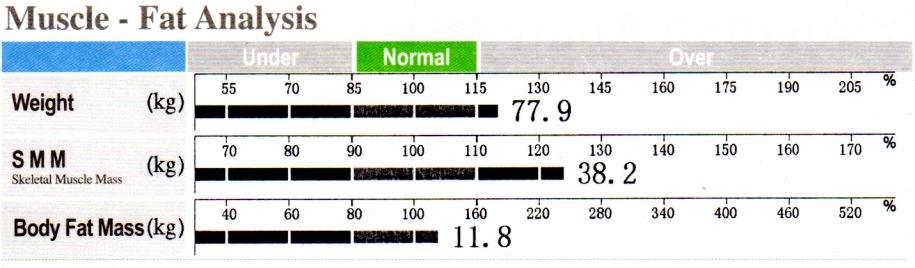
Muscle Fat Analysis

custom macro meal planner

Weight (kg)
Your overall weight – the only thing you see on the conventional scales

SMM (Skeletal Muscle Mass)
This metric show you how much total skeletal muscle mass you have on your body. The body consists of cardiac muscle, visceral muscle, and skeletal muscle. However skeletal muscle can be most transformed through exercise and diet and as such is displayed separately. This number is a good tracking method for those training for muscle gain.

Body Fat Mass (kg)
Shows how many kilograms of body fat you have. This number is a good tracking method for weight loss.

InBody 570 Scan Interpretation Guide

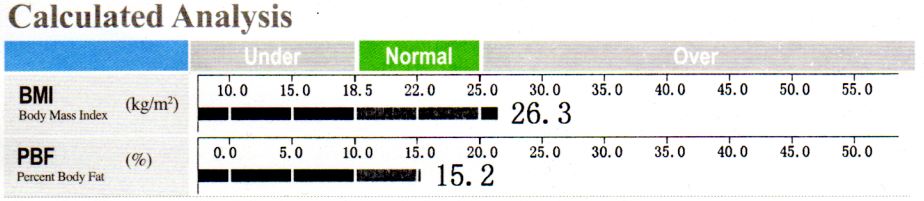
Calculated Analysis

f45 training wollongong

Body Mass Index (BMI)

Calculated by use of a formula that divides your weight by the square of your height and does not take into account your overall body composition. A highly muscled individual may be classified as overweight when using the BMI formula which can be misleading. Although BMI is popular as a metric, it can be inaccurate in some cases.

Percent Body Fat (PBF)

The percentage of your body fat calculated by the total mass of body fat divided by total body mass.  A good indicator of how lean you are. This metric is useful for those aiming for weight loss, fitness/physique competitions, body recompositions and overall health status.

DescriptionWomenMen
Athletes14–20%6–13%
Fitness21–24%14-17%
Average25–31%18-24%
Obese32% and higher25% and higher

CLICK HERE to see some visual examples

Thursday, March 18, 2021

How do Binaural Beats Work?


According to the 2015 literature review, the tones should be at frequencies lower than 1,000 hertz (Hz) for the brain to detect the binaural beat. The binaural beat that a person perceives is the frequency difference between the waves entering the left and right ear. For example, if the left ear registers a tone at 200 Hz and the right ear registers one at 210 Hz, the binaural beat is 10 Hz — the difference between the two frequencies. The review found benefits for memory, attention, stress levels and clarity. Further research is ALWAYS required, but as far as science can tell, Binaural beats actually work!

What Categories of frequencies are there and how do they effect the brain?

Delta pattern: Binaural beats in the delta pattern operate at a frequency of 0.1–4 Hz with links to a dreamless sleep. These frequencies are linked to deep sleep, healing, recovery and rest.

Theta pattern: Binaural beats in the theta pattern range in the frequency of 4–8 Hz. Theta patterns contribute to improved meditation, creativity, and sleep in the rapid eye movement (REM) phase. Theta waves are especially useful for “power naps”

Alpha pattern: Binaural beats in the alpha pattern are at a frequency of 7–14 Hz and may encourage relaxation, learning, flow states and stress reduction.

Beta pattern: Binaural beats in the beta pattern are at a frequency of 14–30 Hz. This frequency range may help promote focussed attention, concentration, problem solving and increased energy

Gamma pattern: This frequency pattern accounts for a range of 30–50 Hz. These frequencies are useful for high level information processing, peak awareness and memory recall

Read More:--> https://www.foundmyphysique.com.au/binaural-beats-101-free-guide/

Saturday, February 27, 2021

Your Personal Guide to Creating a Quick and Easy Calorie Deficit

 Move more, eat less!

It’s that simple right? That’s the simple way of looking at it. You just have to burn more energy than you require and you will lose weight, right?

It would be great if it was that simple. It helps to have an understanding of the following simple concepts

The Calorie Deficit

All diets work due to one consistency, a calorie controlled system with planned eating patterns. Meaningful weight loss requires you to expend more energy than you consume. Each person has a set amount of calories they require to maintain their body mass.

When you consume too more calories than you require you are in a positive energy balance

Positive Energy Balance = Weight Gain

When you consume less, you are in a negative energy balance and you will lose weight

Negative Energy Balance = Weight LOSS!

When you spend a long enough time period in a negative energy balance, you will notice the weight loss. This is called a Calorie Deficit because we are consuming fewer calories than we require.

Most people do not take enough control over their eating for a long enough time period to notice a visible change in their appearance, or often they fall off the eating plan.

Daily Consistency

Hitting your nutritional requirement EACH DAY is also very important.

For example: For Jessica to lose weight she must consume around 1300 calories per day and plus 45 minutes of moderate exercise. Jessica’s food choices are bad and she consumes 1200 calories on Monday, 1700 on Tuesday, 1300 on Wednesday, 1800 on Thursday and this continue on throughout the week. At the end of the week Jessica has not been in a large enough calorie deficit and will not notice any results. Those energy-dense snacks and large portion sizes have thrown Jessica’s eating plan out of whack.

If Jessica had tracked and taken control of her eating she could have maintained the 1300 calories and she would have noticed visible weight loss after 2-3 weeks. She needed to keep consistent on a daily basis instead of having ups and downs in her intake.

The Goal: Maintain your calorie deficit until you are satisfied with your weight loss. When you are satisfied with your weight loss, adjusted your eating to a maintenance calorie level, and enjoy being lean.

How to Figure Out How Many Calories You Consuming

Track it! It’s time to up your nutrition game. Time after time the person who “can’t lose weight” or has “metabolism issue” has often never tracked their nutritional intake enough to realize they are constantly eating too much. 

I would recommend using myfitnesspal to track your food intake, it’s simple and allows for you to scan barcodes and re-enter your regular food items with ease. 

Generally, if you have not gained/lost weight during the past 3 months, you can assume that the number of calories you are consuming is your maintenance level. Track your eating for a minimum of 3 consecutive days and average out the calories to get your maintenance number.

I know the idea of tracking your calories can be a bit overwhelming to some, however, it’s very similar to how you need to track your money in / money out when you want to save money. Knowledge is the key. You may be good for 70% of your diet but 30% of the foods you consume are throwing everything out of whack.

How to Figure Out How Many Calories You Are Burning

You guessed it… it’s time to track that too! Track your workout duration and intensity, plus time spend doing a light activity (LISS). You can add it up on a few online tools to get a vague guestimation of the calories burnt. Also, try to train consistently for the same time period and perceived effort on a regular basis. Most basic trainers recommend you to wear a smartwatch or a heart rate monitor and track the energy you burn, but this technology is nowhere near accurate, so don’t bother. There are too many impacting factors when it comes to using heart rate technology, so unless you are doing steady state cardio and the calculations in the device are calibrated to you, it’s not accurate. That being said, tracking steps per day can be useful as a gauge of incidental activity.

Stay Consistent For ATLEAST 3 Weeks

You may notice changes after one week, sometimes after 2 weeks, however, to really get a clear idea of how you are progressing you will need to stay consistent for at least 3 weeks. After 3 weeks you will notice a change in your weight and sometimes even visual changes in your body composition.

Track Your Progress To Make Sure You are Getting Results

“I think it’s working” is a horrible method of tracking. You need numbers and pictures to compare to each other so to see the changes.Take before/after pictures for yourself, a measurement around your stomach and your weight first thing in the morning on an empty stomach/bladder.

Consult An Expert

Coaches, Nutritionists and Dieticians all have specialities, do some research and find one that specialises in what you are trying to achieve. Sometimes we get the best results when we are held accountable.

I hope that helps, feel free to contact me or comment below and ask questions if you are still unsure of what to do

Stay Frosty

Trainer Simon

Thursday, February 18, 2021

Find a Personal Trainer Near You - Wollongong, NSW


What Is Personal Training? 

A personal trainer can help set fitness goals, create detailed workout plans or routines and also provide guidance on dieting and nutrition. Personal Trainers also provide motivation to get in the gym, go for a run or get active to get the blood pumping. If you’re looking for someone to help you achieve ambitious weight loss or fitness goals, then one-on-one regular personal training sessions are probably what you need. If you’re looking for something more casual, then group outdoor personal training sessions are a great way to stay in shape and meet new people.

Benefits of Personal Training

GET BETTER RESULTS

Working with a personal trainer is more effective than working out alone when it comes to gains to lean body mass and other fitness variables. Source.

CHANGE YOUR ATTITUDE

Personal Trainers can help change attitudes to physical activity. 78% of people are more likely to increase the amount of physical activity they undertake following a 10-week personal training program compared to beforehand. Source.

SOCIAL INTERACTION

Personal training sessions can be a great way to get outdoors, meet new people and enjoy that endorphin rush! Plus, if you attend regular group personal training sessions, you can help motivate one other and hold each other accountable to their goals.

Personal Training Cost

The price for personal training sessions will vary depending on the session duration, the number of people participating and the qualifications or experience of the trainer. Personal training may also be cheaper if you purchase several sessions at once in a package.

A 60 minute session with a qualified personal trainer is usually between $50 and $100, while group sessions range from $10 to $30 for 45-60 minutes. You can usually save up to 30% if you purchase multiple sessions in a package (5 or more), saving you between $15 and $30 per session.

Be sure to ask your personal trainer what qualifications he or she has, how long the sessions are and what discounts are available for bulk sessions to make sure you’re getting a great deal. Also take into account the costs of equipment or facilities hire that you may or may not be required to pay for.

For More Info Visit At:-->

Wednesday, January 20, 2021

Controlling Your Mind: The 5 Hindrances to Self-Mastery

 Lessons from ancient Shaolin wisdom and Marcus Aurelia’s stoic mindset.

When I say mind control, what do you think of?

Many people would think of controlling other people’s minds, but what I am referring to, is controlling your own mind.

Staying in line with our goals and controlling our minds is a life long journey, therefore one would be wise to be aware of these 5 hindrances which can block your path to self-mastery.

The 5 hindrances are states of mind that can distract you from your path. They can control your mind, dampen your energy, and disrupt your spirit. Everyone may experience them slightly differently, that is why I have given a range of examples to fit.

I have also included some wisdom from Marcus Aralias (the wise stoic roman emperor) to show that these ideas transcend time and are valuable lessons to uphold

Let’s dig into the 5 hindrances, and how they are experienced

Ill will / Aversion
Dislike, objection, aversion, frustration

This is a state of mind where your mindset is scattered – making the journey displeasing

Questions to ask yourself –

Am I frustrated with current circumstances?

Is someone bothering me or am I bitching about someone?

What is it that is bothering me lately or distracting me from my path?

Are there people, objects or events in my life which are causing these feelings?

Read More:

https://www.foundmyphysique.com.au/mind-control-the-5-hindrances-to-self-mastery/

Tuesday, December 15, 2020

Realizing Your Fitness Goal With a Personal Fitness Trainer


Realizing your fitness goal with a trainer is a great idea that is fast gaining popularity nowadays. What with the busy schedule and the natural laziness to go to the gym, we need all the help that we can get in order to be fit and healthy. A trainer not only helps you get going with the exercises and the workouts but also helps you with the nutrition side of things.


Personal trainer devices a fitness program that is suited to your body only. Each workout routine and nutrition plan is made with the specific needs of the client which is you. These are only the top two benefits of having a personal fitness trainer. To help you realize your fitness goal, you need all the help that your personal fitness trainer can and will give you. Upon your first meeting, you trainer should conduct numerous physical tests so that he can determine how far he can push you to do the planned workouts as well as your body's system like your blood composition, blood pressure, heart condition and other body functions. Your personal fitness trainer will pinpoint each part of your body that has to go through strength training and parts that needs toning up.

Workouts with your trainer can be done anywhere you want it, be it at the gym, at home or even at the park. This is because a well-rounded and well-planned fitness workout program involves different sets of routines for specific parts of the body and can be done with the aid of things that does not necessarily belong to the gym. Having your own trainer to workout with you will make you more inspired to work out and follow the health and fitness regime that is mapped out specifically for you. You will have someone to push you to do more and to encourage you in case laziness strikes.

The only downside in having your own trainer is the cost. A personal fitness trainer is mostly paid by sessions while some charge a fee for a set number of workouts and others will just charge for individual sessions. Al tough many people assume that having a trainer is expensive, you can actually save money because trainers have all the equipment's you need so you don't have to buy any equipment's. Your trainer will come to the location of your choice with all the materials needed for your workout. If you want to purchase your own equipment's, you personal fitness trainer can help you select the best pieces for you. He can also point you to a good sporting goods store.

Having a personal fitness trainer to help you realize your fitness goal will not only make you stick to your fitness plan but will go a long way towards having a healthy body inside and out.

Simon Jager is the author of this article on Goal with a Personal Fitness Trainer Find more information about Fitness Trainer here.

Wednesday, December 2, 2020

Get A Personal Fitness Trainer For More Positive Results

Losing control on our diet is normal. Laziness sometimes may also be normal. Getting bigger everyday and losing our perfectly formed body figure is also normal but definitely not wanted. We each have our individual differences when it comes to our fitness. Every person is unique not just in terms of physical appearance but as well as in physical performance.

Because of the fact that every individual is unique, it is quite impossible for a fitness trainer to effectively conduct training to a huge number or individuals who each have unique body requirements in working out.

If we want our work out to be effective, we should get a trainer. A trainer can do a personal physical fitness assessment and prescribe us with a fitness program that is especially tailored for our needs. Having a personal fitness trainer to help us in doing our fitness program is a lot more effective than joining a fitness training class where there is just one fitness trainer for everyone.

A personal trainer's attention is not divided into different clients while he is helping you on your work out. You have all his attention so he is able to focus on helping you execute your fitness exercises to make sure that they are done properly and effectively.

A personal trainer can also watch you closely to make sure that the fitness program that he has prescribed to you is effective and he can have it changed if it does not seem to give you any progress at all. A personal fitness trainer will also not just advise you about a healthy diet but will watch your diet to make sure that you are adhering to it. He is able to make sure that you are doing everything on your fitness program accordingly to help you achieve a more effective result.

A personal fitness trainer may be a permanent trainer in a gym or he may be a mobile trainer. If you prefer hiring a personal fitness trainer from a gym, you have to go to the gym where he works regularly so that he is able to help you. If you hire a mobile personal fitness trainer, he can help you work out at any place you like. He can help you work out at your preferred gym if they would allow, he can help you work out at home, at the park or even at your workplace.

A personal fitness trainer is also able to work on extended hours most of the time depending on his availability. You just have to arrange a convenient schedule for both of you so that he is able to help you work out on your preferred time.

A personal fitness trainer can help you improve your physical performance and your body figure or composition more effectively because he is able to give you his full attention. If you have a personal fitness trainer, you do not have to worry about your money, time and effort for working out going to waste because you are definitely able to see good results after your fitness program is completed.

Found My Physique are The Leading Fitness Trainers for Home, Office and Studio. Our services include Wollongong Personal Trainer, Nutritional Consulting, Senior Fitness Programs and more.

Head now to our site Foundmyphysique.com.au and Get Your Road Map to Success!

Friday, November 20, 2020

Introduction - What are Binaural Beats?

Binaural beat therapy is an emerging form of sound wave therapy. It makes use of the fact that the right and left ear each receive a slightly different frequency tone, yet the brain perceives these as a single tone.

Binaural beats are simply just 2 different sound waves (one in each ear) playing at different frequencies. There is a slight difference between the left and right frequency, and the difference is measured in Hz. There are 5 ‘zones’ of frequencies that have been shown to provide slightly different benefits; delta, theta, alpha, beta and gamma (more details below)

Have you ever noticed it can take you 5-10 minutes to really feel like you are “in the zone” when you start reading?

You may have also noticed that it takes some time to quiet the chatter of your brain when you lay down to nap or rest?

There is a GAP there between one state and the next state.

Much of how our brain is operating is dependent on what “State” our brain wave frequencies are in, but this GAP you are noticing between one activity and another is the transition into a new (more synchronised) state.

Side note: There are obviously so many mechanisms that are impacting the way your brain is operating – neurotransmitter balance, stress levels, our thought patterns, biological stresses, sleep deprivation etc… But for the sake of this example, let’s roll with it…

Below is a visual example of how your brainwaves become more in “sync” and you can feel these flow states.

Do Binaural Beats Actually Work?

I know what your thinking, sounds too good to be true right? I was very sceptical at first, however, the literature suggests that these things work and according to a recent 2015 review of the evidence, they have a range of benefits. I have been using Binaural beats for 5 years now and I am convinced they are super effective (for a few specific purposes). Read below on how they work, how to use them and what frequencies to listen to. Dont take my word for it though, It is best to form your own opinion…

Read More Visit At:-->

https://www.foundmyphysique.com.au/binaural-beats-101-free-guide/

Saturday, November 14, 2020

Comparison Syndrome: The Problems With Personal Development And Trait Neuroticism

 The Problem with Personal Development and it’s Links to Trait Neuroticism (TN)

Disclaimer: I am not a psychologist nor do I have an incredibly advanced understanding of neurochemistry. I do however understand a lot of the basic concepts of psychology, motivation and personal development. I have formed my own conclusions that have been incredibly useful for myself, my friends and my clients. I hope you too find these concepts useful, but take them with a grain of salt.

Have you ever experienced a surge of negative emotions but not quite understood where it came from? Have you ever looked at someone who has “everything” and thought to yourself “Ide be so happy if I was them”? You may be experiencing some form of trait neurotism (TN).

How our basic human hard-wiring plays a role in our everyday reality

Humans are neurologically hardwired to be social creatures as we have developed through thousands of years of being tribal animals. Humans, as inherently social creatures, generally try to conform to various ‘norms’ to avoid social ramifications. Consequently, humans assume the ‘traits’ of those around us to better navigate the social landscape. 

“You are the sum of the 5 people you spend the most time around”

Said another way, we are absorbing information from others around us on a subconscious level, ie, body language, facial expressions, acknowledgements, agreement, disagreement etc. We are absorbing this information in order to orientate ourselves in the world. This is how your brain maps out your reality and tries to give you signals to adjust your course of action if need be.

It is all part of our biological programming to orientate ourselves in the world and help the system (the human) survive and replicate. You are hardwired to analyse your behaviour, traits, and actions; helping us avoid bad situations which can reduce your survival and replication and move towards positive situations which may aid and abed our survival and replication. This comes from years of conditioning, from parents, friends, colleagues and yourself. It can also come from seeing others traits, characteristics or actions and then comparing yourself to those traits (also know as comparison syndrome)

But how does this programming work? Why do we experience it? 

It is because we feel these interactions through negative or positive emotions. In psychology this is referred to as the “positive affect system” and “negative affect system”. Vertebrate animals harbour these psychological systems to support their efforts to survive and replicate in a complicated environment. As vertebrate animals ourselves, we too must learn from our mistakes through analysis and observing the mistakes or successful behaviour of others. 

Although humans have access to these two psychological systems, other animals such as dogs are also in-tune with these systems, which allows them to be socially conditioned. Positive and negative rewards are all you need to condition the animal to behave in a suitable manner.

In order to fully understand what trait neuroticism (TN) is, and why all these concepts are important, you need to know how the positive and negative affect system interact with our conscious experience, especially in regard to traits. You also need to understand what I am defining as a trait… so here are some basic definitions:

What Is A Trait?

A trait is a distinguishing quality or characteristic, typically one belonging to a person. You could also refer to these as heireacheys. Anything that can be measured on a scale from 1-10 is in this game, with the masters or leaders being at the top of each trait. Here are some examples: particular skills, appearance, skin, hair, posture, charisma, weight, physique, memory, laziness, work ethic, etc. The list is endless. If you can think of a high level example you can usually think of a low level example and map out the landscape between.

What Is The Positive Affect System?

This is your reward centre in your brain which will make you feel joy, pleasure or satisfaction after you achieve something which you value as a worthy trait or accomplishment.

This is the small spark of joy you feel when you look in the mirror and you are looking good or you have lost weight. Why did you feel great? Because in those situations, you have moved up on your perceived 1-10 scale of that trait spectrum (appearance & physique). Another example is the sense of satisfaction after having an enjoyable social experience or meeting an interesting new person. It is your positive affect system rewarding you.

When people congratulate us or give us attention, we are deeply rewarded. “Good shot”, “well done” and “congratulations on that promotion” are all expressions of social acknowledgment of another’s positive trait or accomplishment. The recipient will soon feel the effects of this social reward from their positive affect system. They have been re-affirmed that they have moved up, or are placing high, on a trait spectrum.

 “Be so great they can’t ignore you” is a classic line from the self-development world, which reminds us that there is a light at the end of the tunnel, all the hard work will eventually get us that sweet reward.

The person who brags or constantly talks about their traits and accomplishments may be addicted to the positive affect system. They may appear self-absorbed to those around them however, they may be unconsciously seeking a small reward from others acknowledging their high trait or accomplishment. They may have the tendency to regularly think or obsess over their high traits, that spark emotion through the positive affect system.

On a subconscious level, when we see people expressing qualities which we deem as a positive trait, we are usually ‘attracted’ to them. Attraction comes in various forms such as eye contact, interest, envy, lust etc. If someone is an outlier in a specific trait such as skill, physical ability, mental ability, natually we watch and we follow. In short, they get our attention. We think “I want to be more like them”. We idolise them and the things they do. We are drawn towards them, thinking that they may facilitate the growth of that trait in ourselves. We do this with our choices in friends, idols, mentors, social contacts and potential mates. We seek others that mirror our traits or that may help us improve our traits.

The qualities we admire in others are usually high-level attributes which we are seeking to reproduce in ourselves. 

You may see someone in the room who has similar traits to you and instantly feel connected to them. I would recommend over the next few days that you try to catch yourself doing this, it can be a very rewarding and consciousness provoking experience.


What Is The Negative Affect System?

The negative affect system, when directed internally, can end in guilt or shame. We constantly think about our own traits, or the traits of others, and make judgements towards ourselves that can result in harsh critique of our own self-worth.

Some consider social media to be bad for self-esteem and ideas of self-worth. Take Instagram for example, users are bombarded by photo-shopped images of those whose lives seem “perfect” and look in better shape than us. If we scroll through Instagram you are bound to think to yourself:

  • “They are in perfect shape”;

  • “I wish I could do that skill”; or

  • “I would be happy if I was on holiday on a tropical island”; or

  • “That is a really nice car”.

In ancient times you would have very little exposure to so many amazing individuals. Your tribe would be 50-500 people and many of which would have similar characteristics. Now that the internet exists, you can easily consume a wide range of things to compare yourself to. 

Many people judge others for having lower level attributes than ourselves, especially if we deem that trait to be valuable. We may despise those who lack the qualities we deem as necessary or fundamental. How fast do we make these judgements? Almost instantly! As soon as you look at another human, on some level your brain is analysing their traits and comparing them to yours. 

Read More